 blog
blog
7 Best Standby Generators for Home Use in 2026
Table of Contents
- Quick Comparison: 7 Best Standby Generators for Home Use
- How to Choose a Standby Generator for Your Home
- Whole House Generator Sizing Guide
- Standby Generator Installation Cost and Permitting
- Standby Generator Maintenance Schedule and Longevity
- Smart Home Integration and Remote Monitoring
- Noise Levels, Safety Features, and HOA Compliance
- Conclusion
- Frequently Asked Questions
Last Updated: September 30, 2026
Quick Comparison: 7 Best Standby Generators for Home Use
Standby generators are permanently installed backup power systems that start automatically within seconds of an outage and run on natural gas or liquid propane. They connect to your home's electrical panel through an automatic transfer switch and require professional installation. This guide from Hriczak Electrical Contracting LLC covers the seven best standby generators for home use in 2026, plus sizing, installation, and maintenance guidance.
| Model | Output | Fuel | Best For |
|---|---|---|---|
| Generac Guardian 26kW | 26 kW | Natural gas / LP | Whole-house coverage |
| Generac Guardian 24kW | 24 kW | Natural gas / LP | Larger homes |
| Kohler 26RCA | 26 kW | Natural gas / LP | Cold-climate reliability |
| Generac Guardian 18kW | 18 kW | Natural gas / LP | Mid-size homes |
| Champion 14kW | 14 kW | Natural gas / LP | Budget-conscious buyers |
| Briggs & Stratton 12kW | 12 kW | Natural gas / LP | Essential circuits only |
| Cummins RS20A | 20 kW | Natural gas / LP | Quiet operation |
How to Choose a Standby Generator for Your Home
Choosing the right standby generator comes down to three variables: how much power your home needs, which fuel source is available, and where the unit can legally sit.
Power Output and Wattage Requirements
Rated wattage is the power a generator delivers continuously; surge wattage is the brief higher output needed to start motors in air conditioners, well pumps, and refrigerators. Size for surge, not just running load, central air conditioning alone can demand two to three times its running wattage at startup.
Fuel Source Comparison: Natural Gas vs. Liquid Propane
Natural gas is more convenient where a municipal line reaches the house: the supply never runs out during a regional outage and there is no tank to refill. The trade-off is slightly lower power output than propane on the same unit.
Whole House Generator Sizing Guide
Whole house generator sizing starts with a professional load calculation, not a guess based on square footage. Two identical-size homes can need very different generators depending on whether they run electric heat, a well pump, or a sump system.
Use this decision framework:
- Up to 12 kW: Essential circuits only. Furnace, refrigerator, sump pump, a few lights, internet, and phone charging.
- 14-18 kW: Mid-size homes. Adds central air, well pump, and most kitchen appliances.
- 20-24 kW: Larger homes with multiple HVAC zones, electric water heating, or an EV charger.
- 26 kW and above: Whole-house coverage including everything running at once.
Standby Generator Installation Cost and Permitting
Standby generator installation cost is the number most buyers underestimate, the generator itself is only part of the invoice. A typical residential project breaks into five line items.
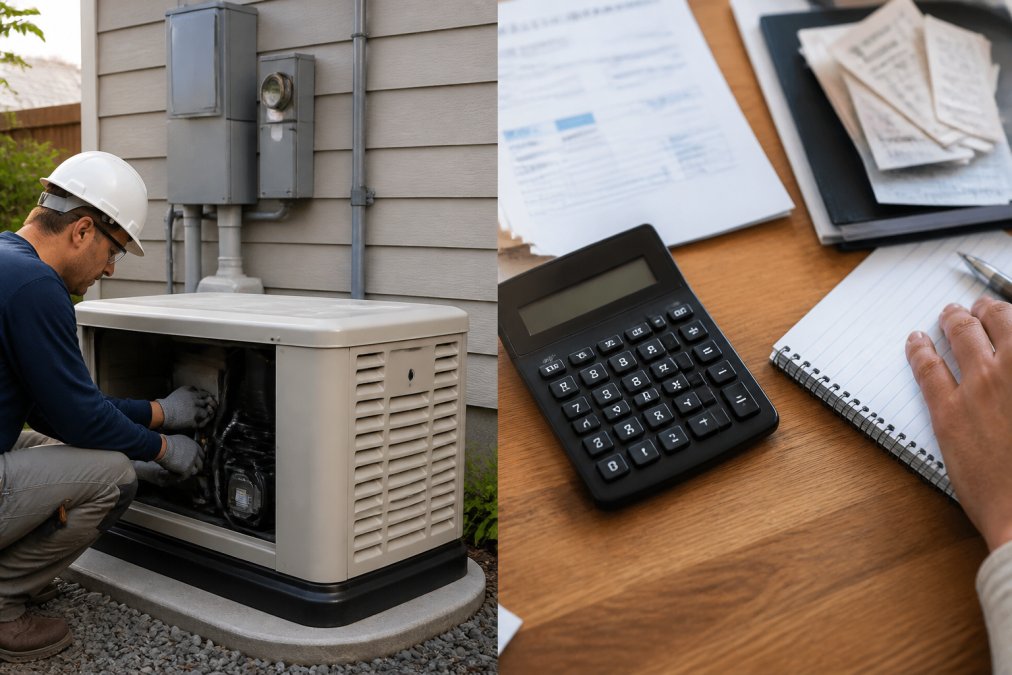
- Generator unit: The largest single line. Air-cooled home units run from roughly $2,000 for a small essential-circuits model to $6,000 or more for a 26 kW whole-house unit. Liquid-cooled units climb higher.
- Automatic transfer switch: Often bundled with the generator, but a whole-house service-rated switch costs more than an essential-circuit switch. Confirm whether the quote includes it or lists it separately.
- Electrical labor and permit: A licensed electrician runs the feeder from the generator to the transfer switch and from the switch to the panel. Panel age matters, an older panel with no spare capacity may need a service upgrade first.
- Fuel connection: A natural gas line extension from the meter, or a propane tank and regulator set. Long gas runs and trenching are the most common source of surprise charges.
- Site prep: A concrete or composite pad, plus clearance from windows, doors, and vents per the manufacturer's installation manual.
Permitting: What Actually Gets Filed
Most jurisdictions require at least an electrical permit for the transfer switch and generator circuit, with a final inspection before the utility approves the connection. Many also require a separate gas permit, and some a zoning or building permit for the pad and enclosure. Three practical rules:
- Ask who pulls the permit. A legitimate installer pulls it in their own name. If a contractor asks you to pull it as the homeowner, that shifts liability and inspection risk onto you.
- Confirm the inspection sequence. The electrical rough-in is usually inspected before the utility reconnects, and the gas line is pressure-tested separately. A missed inspection can delay energizing the unit by weeks.
- Get the quote itemized. Ask specifically whether the price includes the permit fee, the pad, the transfer switch, the gas connection, and any panel work. Those five items are where quotes diverge.
Automatic Transfer Switch Functionality
An automatic transfer switch detects a utility outage, starts the generator, and switches your home from grid to generator power, then reverses the process when the grid returns. Transfer time typically runs 10 to 30 seconds.
Standby Generator Maintenance Schedule and Longevity
A standby generator maintenance schedule separates a unit that lasts 15 years from one that fails on the first cold night of an outage. Most manufacturers recommend service every six months or 200 hours of run time, whichever comes first; air-cooled units in dusty or coastal environments need it sooner.
The First 30 Days After Installation
The first month is when installation problems surface, and catching them early is far cheaper than catching them during an outage. A post-install checklist:
- Week 1, verify the exercise cycle. Confirm the unit ran its scheduled weekly self-test and that the transfer switch logged the event. If the app or control panel shows no exercise record, call the installer before the next storm.
- Week 1, check for fuel leaks and regulator noise. A faint gas odor or a whistling regulator at the meter indicates a connection that needs tightening. Shut the fuel off and call the installer.
- Week 2, run a live load test. With the installer present, kill the utility feed at the main breaker and confirm the generator picks up the load, runs for several minutes, and transfers back cleanly when utility power returns. This is the most valuable test you can do, and many installers will perform it as part of commissioning if asked.
- Week 3, confirm the permit inspection is closed. An open permit can block warranty service and complicate a future home sale.
- Week 4, register the warranty. Most manufacturers require registration within a set window after installation, and unregistered units can lose coverage on parts.
Ongoing Maintenance Tasks
- Change the oil and oil filter at each service interval
- Replace the air filter and spark plugs annually
- Inspect and test the battery, replacing every two to three years
- Check the automatic exercise cycle, which runs the unit weekly
- Inspect the enclosure for corrosion and clear debris from vents
- Test the transfer switch under load once a year
- Check the fuel regulator and flexible gas connector for cracking
The weekly automatic exercise cycle is your early warning system: if the unit stops exercising, something is wrong before you ever need it. The most common failure point is a dead battery; the second is a clogged air filter on units near landscaping or under trees.
What Maintenance Actually Costs
A typical air-cooled service visit, oil, filter, spark plug inspection, battery test, and a visual check of the enclosure and connections, is routine, and many owners choose an annual or semi-annual service plan rather than paying per visit. Liquid-cooled units cost more to service because they have a larger oil capacity, a coolant system, and more frequent valve adjustments. Budget for the plan like HVAC maintenance: it is cheaper than a mid-outage repair.
Longevity: What Shortens It
Three factors dominate how long a unit lasts:
- Exercise discipline. A generator that never runs between outages develops fuel system and battery problems. The weekly exercise cycle is not optional.
- Load matching. A unit that is consistently overloaded, running more starting watts than it is rated for, wears faster than one sized correctly. This is why the load calculation matters more than the brand.
- Environment. Coastal salt air, heavy pollen, and rodent nesting in the enclosure all shorten service life. A quick seasonal inspection of the vents and wiring compartment catches most of it.
Smart Home Integration and Remote Monitoring
Smart home integration lets you monitor generator status, fuel level, and run history from a mobile app instead of checking a control panel outside. Most current Generac and Kohler models support Wi-Fi or cellular modules that push alerts when the unit exercises, faults, or loses connection.
Noise Levels, Safety Features, and HOA Compliance
Noise ratings for home standby generators typically fall between 60 and 67 dB at 23 feet, roughly the level of normal conversation. Quieter units cost more but matter if the generator sits near a bedroom window or property line.
Conclusion
The hard part of buying a standby generator is not picking a model. It is getting the sizing, fuel source, permitting, and placement right so the unit actually runs when you need it. That is where an experienced installer earns their keep.
Frequently Asked Questions
Which brand of standby generator is the most reliable?
Reliability depends on proper sizing, installation, and maintenance more than brand alone. Generac and Kohler are the most widely installed brands in the U.S. and both carry strong track records for residential use. A generator that is correctly sized for your home's load, installed by a licensed electrician, and serviced on schedule will outlast a larger unit that is neglected. Ask any installer about their service network before choosing a brand.
What is the best standby generator for a whole house?
The best standby generator for a whole house is one sized to your home's actual electrical load, not the biggest unit on the shelf. A typical home needs a unit that covers the circuit breaker panel's calculated demand, including surge wattage for air conditioning and well pumps. Whole-house power also requires an automatic transfer switch rated for your service amperage. A licensed electrician can perform a load calculation to match kilowatt capacity to your home.
How much does it cost to install a home standby generator?
Standby generator installation cost depends on the unit size, fuel source, distance from the circuit breaker panel, and local electrical permit fees. Natural gas connections, concrete pads, and transfer switch wiring all affect the total. Because every home is different, a firm quote requires an on-site evaluation. Contact a licensed electrician for a personalized estimate rather than relying on national averages.
Do standby generators require regular maintenance?
Yes. A standby generator maintenance schedule typically includes oil and filter changes, air filter replacement, spark plug inspection, and battery checks, usually once a year or every 200 hours of run time, whichever comes first. Automatic exercise cycles run weekly to keep the engine ready. Skipping maintenance is the most common reason generators fail during an outage, so schedule service with a qualified technician.