 Ultimate guide
Cost of Installing an EV Charger at Home: Full Guide
Last Updated: November 19, 2026
Quick Summary
EV charger installation at home typically costs $749 to $2,500 for a Level 2 setup, with Qmerit's 2026 benchmark averaging about $1,700. That range covers electrical labor and often excludes the charger itself, which costs $400 to $1,000. Panel capacity, distance from the panel, and indoor or outdoor placement all change the final price.
- Level 2 charging needs a 240-volt circuit, which drives most of the installation cost.
- The EPA lists $300 to $2,000 for electrician installation.
- Ask for a load calculation to learn whether your panel can support a charger.
- Most installs require an electrical permit and inspection, with fees set by your municipality.
- Get a written quote that itemizes equipment, labor, permit fees, and any panel work.
Table of Contents
If you're weighing the cost of installing an EV charger at home, the national picture is roughly $749 to $2,500 for a typical Level 2 installation. Qmerit's 2026 benchmark puts the average around $1,700 (Qmerit 2026 EV charger installation cost benchmark). That range covers labor and the electrical work, but it does not always include the charger itself.
The U.S. Department of Transportation's ITS Knowledge Resources estimated an average of $1,400 to install Level 2 chargers and outlets for a single-family house (U.S. Department of Transportation estimate of Level 2 outlet and charger installation costs). That figure is older, so treat it as a baseline rather than a current quote. Your final price depends on how far the charger sits from your panel, whether the panel has spare capacity, and whether the work is indoors or outdoors.
Our advice is to get a site-specific quote before you buy hardware. The same charger can cost very different amounts to install depending on those factors.
Level 1 Versus Level 2 Charging: Which Costs More to Set Up?
Level 1 charging plugs into a standard 120-volt household outlet and usually needs no new installation. Level 2 charging runs on a 240-volt circuit, which is the type most home EV chargers use. That circuit is where nearly all of the installation cost comes from.
For most owners, a Level 1 setup costs little more than a cord, while a Level 2 setup requires a dedicated circuit, breaker, and charger. Level 2 charges much faster, which is why it is the common choice for daily home charging.
Charger Equipment Cost Versus Electrician Labor
The total bill has two parts: the charger and the installation. The EPA lists $400 to $1,000 for a generic Level 2 wall charger and $300 to $2,000 for electrician installation (U.S. EPA guide to home EV charging costs). Car and Driver reports an average upfront equipment cost of $400 to $700 (Car and Driver guide to home EV charger equipment costs).
Ask any electrician to itemize equipment, labor, permit fees, and materials so you can compare quotes fairly.
How Panel Capacity and Electrical Panel Upgrades Change the Price
Your electrical panel determines whether a charger can be added without other work. If the panel has enough spare capacity and open breaker space, the job stays relatively simple. If not, you may need a load calculation, a panel upgrade, or a load management device that limits charging when other appliances run.
Ask for a load calculation before accepting a quote so you understand whether your panel has the capacity for a charger.
Sample Itemized Quotes for Common Home Layouts
Quotes vary by layout. Ask each electrician to show the cable run length, breaker size, and any conduit or trenching separately so the numbers are comparable.
Permits, Incentives, and How to Verify Current Rules
Most EV charger installs require an electrical permit and inspection, and fees vary by municipality. Check your local building department and your utility's website for current rules before you commit. Our local electrical code and inspection guide explains which requirements usually apply to a home charger install.
Getting a Firm Quote Before Your Home EV Charger Installation Starts
Before any home EV charger installation begins, request a written quote that lists equipment, labor, permit fees, and any panel work. At Hriczak Electrical Contracting LLC, our licensed electricians can assess your panel and wiring. Contact us through our website to get a quote and schedule a site visit.
Frequently Asked Questions
How much does it cost to add an EV charger to your house?
Your final number depends on the distance from your electrical panel, whether your panel needs an upgrade, and local permit fees. Ask for an itemized quote so you can compare equipment and labor separately.
Is it worth installing an EV charger at home?
For most electric vehicle owners, a home charger is worth the investment because it lets you charge overnight at a lower cost than public fast-charging stations. A Level 2 charger typically adds the most useful range per hour of charging, which matters for daily commuting. The upfront cost of installation can be recovered over time through avoided public charging fees. Whether it pays off for you depends on your driving habits, your local electricity rates, and any available incentives.
Is there an IRS tax credit for EV charger installation?
Federal tax credits for home EV charger installation have changed over time, so you should verify current eligibility before you budget around one. Eligibility rules, credit amounts, and income or property requirements can change through legislation or IRS guidance. Check the IRS website and consult a qualified tax professional before you assume a credit applies. Some state and utility rebates may also be available, and those rules are separate from federal tax treatment.
How much does it cost to install a Level 2 charger at home?
The cost of a Level 2 charger installation depends on equipment and professional labor combined. Costs rise when the charger sits far from the electrical panel, when a 240-volt circuit must be run through finished walls, or when the panel needs an upgrade. Get written quotes that break out each cost category.
What electrical upgrades can increase the cost of installing a home EV charger?
The most common upgrade that raises cost is an electrical panel replacement or service upgrade, often needed when the existing panel lacks capacity for a new 240-volt, 40-amp or 50-amp circuit. Other added costs include a longer cable run from the panel to the charger location, trenching for outdoor installations, and dedicated circuit breakers. Load management devices can sometimes avoid a full panel upgrade by limiting charging power when other large appliances are running. A licensed electrician can assess your panel and recommend the least costly safe option.
How can I estimate the cost of installing an EV charger at home?
Start with the national average range for Level 2 installation, then adjust for your specific conditions. Add points for distance from the panel, panel capacity, indoor versus outdoor mounting, and permit fees, which vary by municipality. A home electrical assessment gives the most accurate estimate, since an electrician can confirm whether your panel has room for a dedicated circuit. Confirm the estimate with written quotes from licensed electricians.
What does an EV charger installation labor cost include?
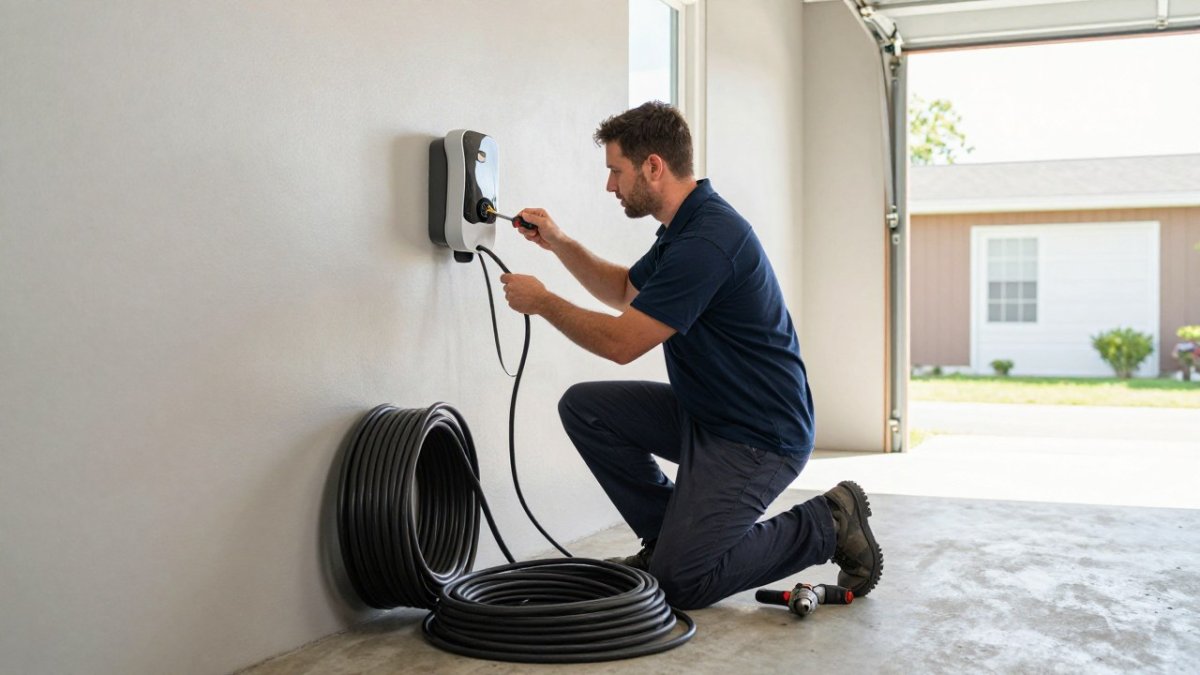
EV charger installation labor covers the electrician's time to mount the unit, run wiring from the panel, install a dedicated circuit breaker, and connect and test the charger. Labor is often the larger share of the total cost when the install requires long wire runs, drywall or masonry work, or a panel upgrade. Some contractors also include permit handling and final inspection in the labor price, while others bill those separately. Ask each quote to state what is included.