 how-to
7 Steps to Hiring a Trusted Electrician in Phillipsburg NJ
Last Updated: October 26, 2026
Quick Summary
To hire a trusted electrician Phillipsburg NJ homeowners should verify the license and insurance, confirm the contractor pulls the permit, and get an itemized written estimate before work starts. Ask who performs the work and what the quote excludes, and treat burning smells, scorch marks, or buzzing panels as emergencies.
- Verify the license number and insurance certificate before anyone sets foot in your home.
- A legitimate electrician pulls the permit in their name and schedules the inspection.
- A written, itemized estimate should list permit fees and state what is excluded.
- A Level 2 EV charger needs a load calculation to confirm your panel has capacity.
- Burning smells, scorch marks, or buzzing panels justify an immediate emergency call.
Table of Contents
- Why Hiring a Licensed Electrician in Phillipsburg NJ Matters
- Step 1: Define the Electrical Project and Your Budget
- Step 2: Verify Licensing, Insurance, and Local Permits
- Step 3: Request an Electrical Contractor Estimate in Writing
- Step 4: Understand the Electrician Hourly Rate in New Jersey
- Step 5: Plan for EV Charger Installation in Phillipsburg NJ
- Step 6: Know When to Call for Emergency Electrical Service
- Step 7: Questions to Ask Before You Hire an Electrician
- Frequently Asked Questions
Why Hiring a Licensed Electrician in Phillipsburg NJ Matters
Older Lehigh Valley housing stock means aging wiring, undersized service panels, and aluminum branch circuits never designed for modern loads.
Hriczak Electrical Contracting LLC has worked on residential, commercial, and industrial systems for over 18 years, and we have seen what happens when a homeowner hires the cheapest quote from an unlicensed truck.
Below are seven steps for hiring an electrician in Phillipsburg, from scoping the project to asking the questions that separate a professional from a gambler.
| Step | What You Do | Why It Matters |
|---|---|---|
| 1 | Define the project and budget | Prevents scope creep and surprise charges |
| 2 | Verify license, insurance, permits | Protects you from liability |
| 3 | Get a written estimate | Creates a fixed reference point |
| 4 | Understand the hourly rate | Lets you compare quotes fairly |
| 5 | Plan EV charger work carefully | Load capacity decides feasibility |
| 6 | Know emergency triggers | Prevents injury and fire |
| 7 | Ask the right questions | Reveals who actually does the work |
Step 1: Define the Electrical Project and Your Budget
Write down exactly what you want before you call anyone. "Some outlets don't work" is not a project description; "two kitchen circuits trip when the microwave and toaster run together" is.
Group your project into one of three buckets:
- Repair: a dead outlet, a tripping breaker, a flickering light, a failed fixture
- Installation: new circuits, EV charger, generator, lighting, panel replacement
- Upgrade: service panel capacity increase, whole-home rewiring, code compliance work
Budget expectations shift dramatically between these. A repair is a service call. A panel upgrade is a day of work plus materials plus a permit. Rewiring a 1950s home is a multi-day project with drywall repair involved.
If your project is commercial or industrial, the hiring process changes. Our guide on how to hire a commercial electrical contractor near me covers the additional requirements, and the industrial electrician hiring guide walks through control panels, PLC integration, and downtime planning.
Step 2: Verify Licensing, Insurance, and Local Permits
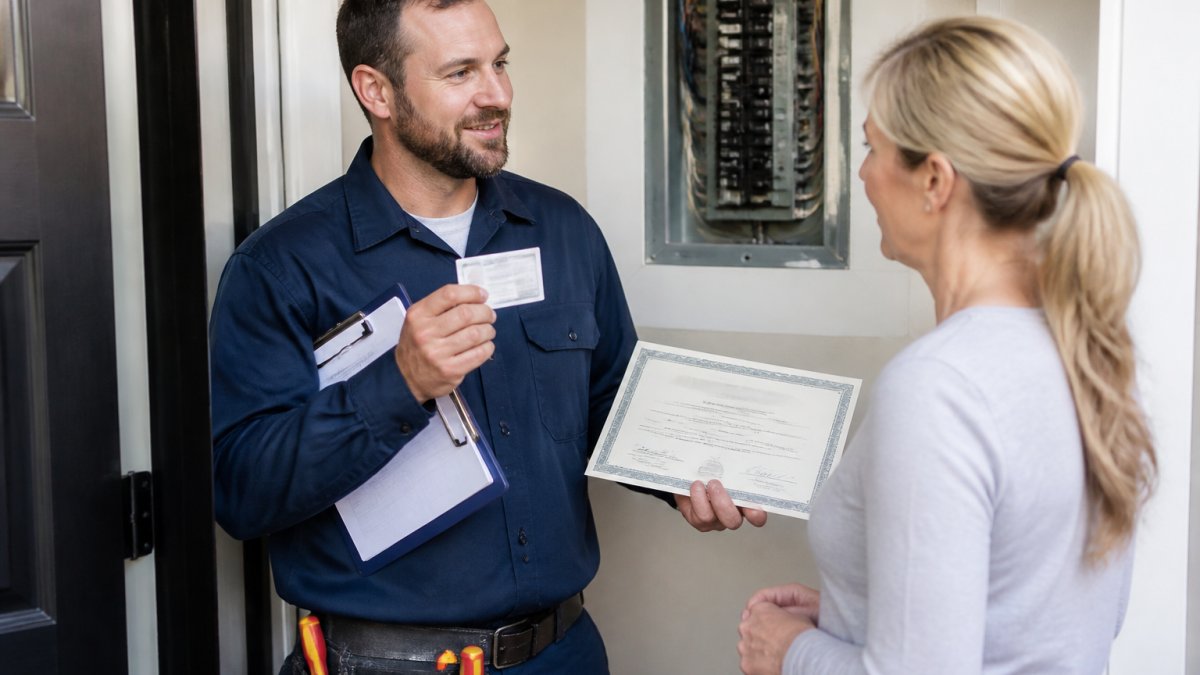
Ask for the license number and verify it before anyone sets foot in your home. New Jersey requires electrical contractors to hold a valid license, and Phillipsburg work is subject to local code enforcement and inspection.
Here is what to confirm:
- A current electrical contractor license number you can look up
- General liability insurance with a certificate you can see
- Workers' compensation coverage for anyone on your property
That last point matters: if a contractor asks you to pull the permit as the homeowner, they are shifting the inspection risk onto you. A legitimate electrician pulls the permit and schedules the inspection.
How to actually verify a license and insurance
A license number on a business card proves nothing until you check it. In New Jersey, electrical contractors are licensed through the Board of Examiners of Electrical Contractors under the Division of Consumer Affairs, and the lookup is public.
For insurance, ask for a certificate of insurance (COI) sent directly from the insurer or agent, not a photocopy from the truck. It should show general liability and, if employees will be on your property, workers' compensation.
Permits and inspections: what to expect
Most jurisdictions require a permit for work that adds or alters circuits, replaces a service panel, installs an EV charger or generator connection, or does significant rewiring.
When a permit is pulled, the contractor submits the application with a scope description, performs the work, and the municipal electrical inspector reviews it, often in phases for larger jobs (rough-in before drywall, final after fixtures and devices).
Where to confirm current requirements
Code requirements and permit thresholds are set locally and can change. For a detailed walkthrough, see our local electrical code compliance and inspection guide.
Step 3: Request an Electrical Contractor Estimate in Writing
An electrical contractor estimate should be in writing, itemized, and specific enough that two contractors are quoting the same scope. Verbal ballparks are how "surprise charges halfway through the job" happens.
A usable estimate includes:
- Labor and materials broken out separately
- Permit fees listed as a line item
- A stated scope: what is included and, just as important, what is not
Watch out: a quote dramatically lower than every other bid usually means something is missing, not that you found a bargain. Ask each contractor what their quote excludes, the answer is often more revealing than the total.
Step 4: Understand the Electrician Hourly Rate in New Jersey
The electrician hourly rate in New Jersey varies by job type, and comparing on rate alone is a mistake: a lower rate paired with a longer estimated duration can cost more than a higher rate with a tight scope.
Most residential work falls into three billing structures:
- Flat-rate service call: a fixed fee for diagnosis and a defined repair window
- Hourly plus materials: common for troubleshooting and smaller installs
- Project bid: a fixed price for defined installation or upgrade work
When you compare quotes, ask each contractor which structure they use and what triggers additional charges. Emergency calls, after-hours work, and attic or crawlspace access commonly carry adjustments. Get those in writing up front.
The honest answer to "why is your rate higher than the other guy's" is usually scope, insurance, and who actually performs the work.
Step 5: Plan for EV Charger Installation in Phillipsburg NJ
EV charger installation Phillipsburg NJ homeowners ask about most often comes down to one question: does the panel have capacity?
Before you get a quote, gather these facts:
- The amperage of your current service panel
- The round-trip distance from the panel to where the charger will mount
- Whether the charger is hardwired or plug-in
Distance drives conduit, wire gauge, and labor: a charger on the far side of a finished garage from the panel is a different job than one mounted directly behind it.
A common mistake is buying the charger first and asking about installation later. For a breakdown of what the circuit work typically costs, see our cost of adding EV charger circuits guide.
Step 6: Know When to Call for Emergency Electrical Service
Call for emergency electrical service immediately if you smell burning, see scorch marks, hear buzzing from a panel, or have a breaker that will not reset. These are fire-risk signals, not inconveniences, do not wait until morning or "keep an eye on it."
Situations that justify an emergency call:
- Burning smell or visible smoke from an outlet, switch, or panel
- Warm or discolored cover plates
- Repeated breaker trips after reset
Situations that can wait for a scheduled visit:
- A single dead outlet with no other symptoms
- A light fixture that needs replacing
- A tripping GFCI that resets normally
Why the warning signs matter
Most electrical fires do not start with a dramatic spark, they start with heat. A loose connection at a backstabbed receptacle or failing breaker terminal creates resistance, and resistance creates heat behind the wall, often with no visible flame until surrounding material ignites. That is why a warm cover plate or faint burning smell is urgent even when everything still "works." Buzzing at a panel usually means arcing, which ignites a large share of residential electrical fires, and repeated breaker trips mean the system is overloaded or faulted, resetting without diagnosis turns a nuisance into a hazard.
A simple triage framework
Use three questions to sort a problem:
- Is there heat, smoke, or a burning smell? If yes, treat it as an emergency. Shut off the affected circuit at the panel if you can do so safely, and call.
- Is there arcing, sparking, or buzzing? If yes, treat it as an emergency. Do not touch the device or panel; call.
- Is it isolated and stable? A single dead outlet, a fixture that needs replacing, or a GFCI that resets and stays on can usually wait for a scheduled visit, but note it and get it looked at rather than ignoring it.
What to do while you wait
If you smell burning or see smoke, get everyone out and call 911 first, then call the electrician. If the hazard is at a single device, stop using it and, if you can safely reach the panel, switch off that breaker.
As an electrician Phillipsburg homeowners can call around the clock, Hriczak Electrical Contracting LLC runs 24-hour emergency service, which matters when the problem is at 2 AM and the panel is buzzing.
Step 7: Questions to Ask Before You Hire an Electrician
Ask these questions on the phone, before you book. Our guide to hiring a licensed electrician in Quakertown offers a parallel checklist you can use to cross-check the answers. The answers tell you more than any review page will.
- Are the electricians on staff licensed, or do you subcontract? You want to know who is in your house.
- What is your license number, and can you send proof of insurance? A pause here is a red flag.
- Will you pull the permit, and who schedules the inspection? The answer should be them.
- What does the estimate exclude? Drywall repair, fixture cost, and permit fees are common exclusions.
- How do you handle a job that turns out bigger than expected? You want a stop-and-approve policy, not a surprise invoice.
- What is your workmanship warranty? Get the term and what it covers.
- What is your emergency response time? "24/7" means nothing without a real answer.
- Can you provide references for similar work? Recent, local, and comparable to your project.
Hriczak Electrical Contracting LLC holds Philadelphia Master License #061283 and Bethlehem Master License #M-213, and we are happy to send proof of insurance before you ask.
Frequently Asked Questions
How much does an electrician charge per hour in NJ?
The electrician hourly rate New Jersey homeowners pay varies by contractor, job complexity, and whether it is emergency or scheduled work. Most licensed electricians bill a service call fee plus an hourly rate, and some quote flat rates for common jobs like outlet replacement or panel upgrades. Because pricing depends on the specific project, ask for a written electrical contractor estimate before work begins. Hriczak Electrical Contracting LLC provides transparent quotes so you know the cost upfront.
Can a handyman do electrical work in New Jersey?
No. New Jersey requires electrical work to be performed by a licensed electrician, and most municipalities require permits and inspections for anything beyond minor replacements. A handyman cannot legally run new wiring, install circuits, or replace a panel. Hiring an unlicensed worker risks failed inspections, insurance issues, and fire hazards. Always verify the electrician holds a valid NJ license and carries liability insurance before allowing any electrical work in your home.
How do I check whether an electrician is licensed and insured?
Ask for the license number and verify it through the New Jersey Division of Consumer Affairs online license lookup. Confirm the contractor carries general liability insurance and workers' compensation by requesting a certificate of insurance. A reputable electrician will provide these without hesitation. Hriczak Electrical Contracting LLC holds Philadelphia Master License #061283 and Bethlehem Master License #M-213 and can share proof of insurance on request.
What should I ask an electrician before hiring them?
Ask whether they are licensed and insured, if they will pull the required permits, who will perform the work (staff or subcontractors), and whether they offer a workmanship warranty. Request a written estimate that itemizes labor and materials. Also ask about availability for emergency calls and response time. Hriczak Electrical Contracting LLC has over 18 years of experience, uses licensed staff, and offers 24-hour emergency service so you are not left waiting during an outage.
Hiring an electrician is a trust decision, and the paperwork is how you verify the trust. If you want a straight answer on scope, permits, and what your project actually requires, Hriczak Electrical Contracting LLC brings over 18 years of residential, commercial, and industrial experience, licensed and certified electricians on staff, and 24-hour emergency availability. Get a quote and we will walk your panel, your project, and your options before anyone picks up a tool.