 How-to
7 Steps to Identify Knob and Tube Wiring in Your Home
Last Updated: October 30, 2026
Quick Summary
To identify knob and tube wiring, look for white ceramic knobs nailed to wood framing and ceramic tubes lining drilled holes, with separate cloth-covered copper wires running parallel and never bundled. Check the attic, basement, and crawl space first, then look for clues like two-prong outlets and fuse boxes in finished rooms.
- Use only your eyes and a flashlight, and never touch bare wire or open a panel cover.
- Porcelain knobs are round ceramic insulators with a groove where the wire wraps around.
- Knob and tube circuits usually have no ground wire, so two-prong outlets are a red flag.
- Only a licensed electrician can confirm whether visible knob and tube is still energized.
- Wire nuts joining old cloth wire to modern wire are signs of later modification.
Table of Contents
- Step 1: Gather Tools and Set Safety Ground Rules Before You Inspect
- Step 2: What Does Knob and Tube Wiring Look Like?
- Step 3: Where to Find Knob and Tube Wiring in an Old House
- Step 4: Check Outlets, Switches, and the Electrical Panel Safely
- Step 5: How to Verify Whether the Wiring Is Energized
- Step 6: Distinguish Original Knob and Tube from Later Modifications
- Step 7: What a Knob and Tube Wiring Inspection Covers
- Knob and Tube Wiring Replacement Cost: What Drives the Price
- Frequently Asked Questions
Step 1: Gather Tools and Set Safety Ground Rules Before You Inspect
Learning how to identify knob and tube wiring step by step starts with knowing what to look for and, more importantly, what not to touch.
Knob and tube wiring is an early electrical method that runs single-insulated copper conductors through wall cavities, held apart by ceramic insulators.
Gather a few basic items before you start:
- A bright flashlight with a narrow beam
- A phone camera for photos
- A notepad to log what you find
Set three ground rules now. Never touch bare wire. Never open a panel cover. Never poke inside a wall cavity.
Watch out: the biggest mistake is assuming old-looking wire is dead. It might still carry current.
Step 2: What Does Knob and Tube Wiring Look Like?
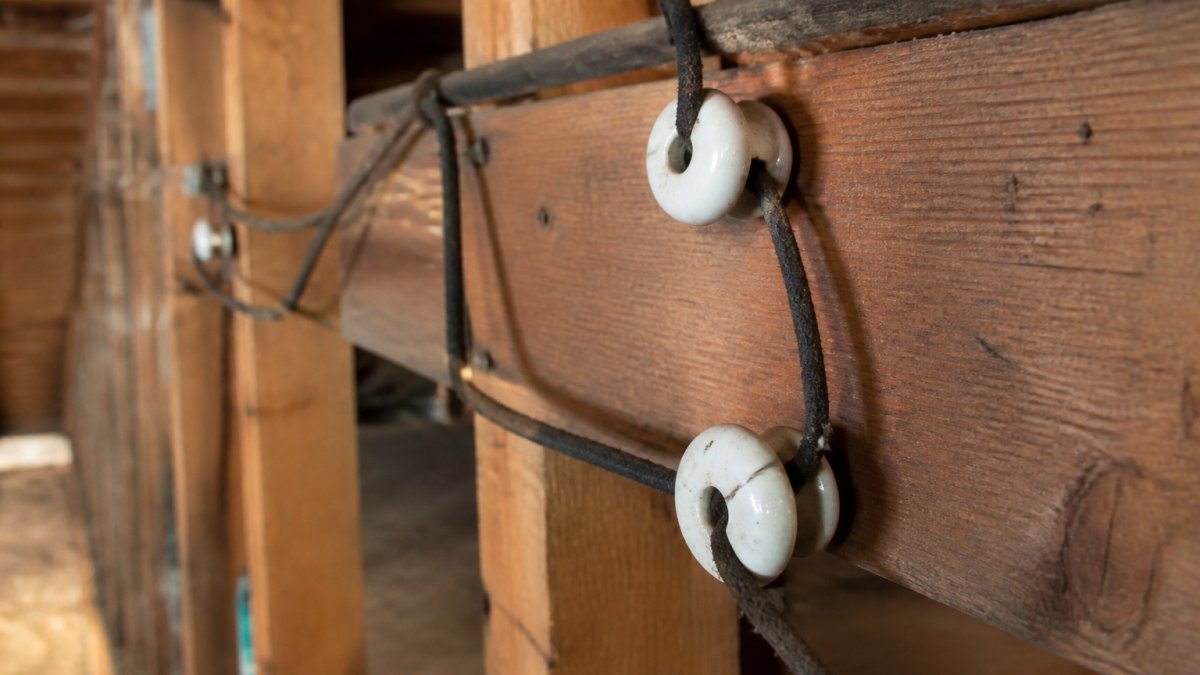
Knob and tube wiring is easy to spot once you know the shapes. It uses white ceramic knobs nailed to wood framing and ceramic tubes that pass through drilled holes. The wires are separate, never bundled.
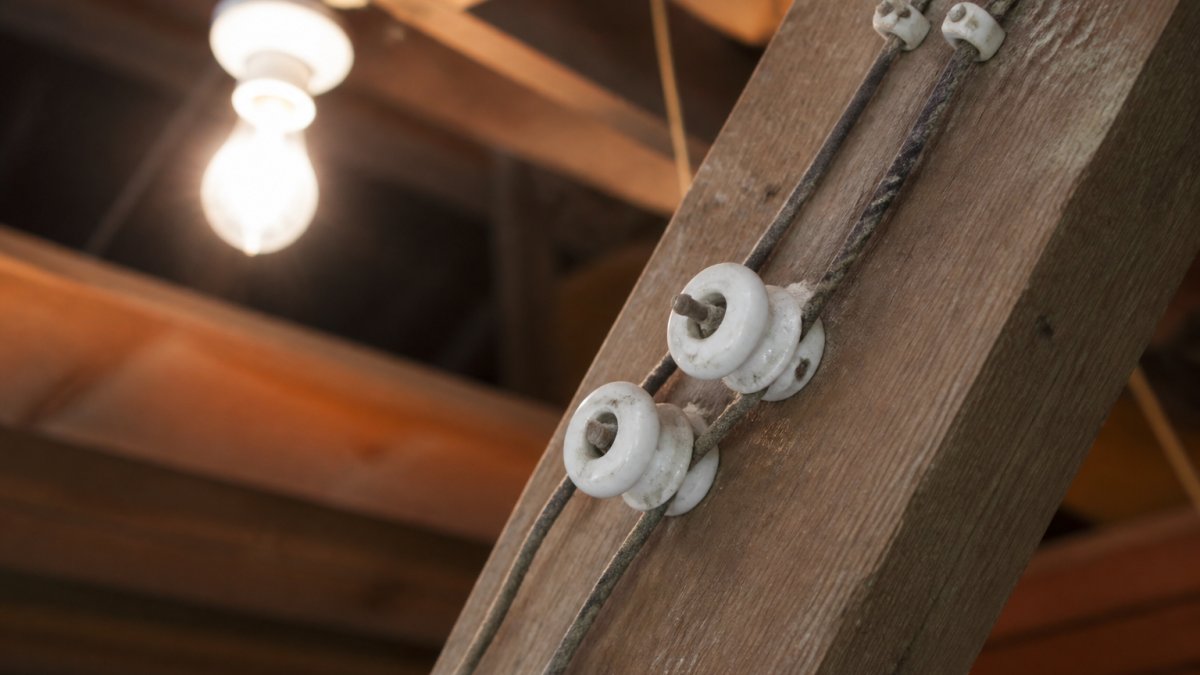
Porcelain Knobs, Tubes, and Cloth-Covered Copper
Porcelain knobs are round, ceramic insulators with a groove around the edge. The wire wraps around the groove and stays off the wood.
Porcelain tubes are short ceramic cylinders. They line holes drilled through joists so the wire doesn't rub on wood.
The copper conductor itself is usually single-insulated. Older runs have cloth-covered wire, often black or white. Some runs show cracked rubber insulation.
That separation is the tell. If you want a wider guide to spotting other outdated wiring types in an older home, see how to identify outdated wiring in old homes.
Step 3: Where to Find Knob and Tube Wiring in an Old House
Knob and tube wiring shows up in unfinished spaces first, but the most useful identification work is a room-by-room walkthrough that tells you where to look without opening anything. The attic, basement, and crawl space are the best starting points because the framing is exposed, but you should also know which finished rooms and building features raise the odds.
Start with the unfinished spaces
Work through these in order, using only your eyes and a flashlight:
- Attic. Look along ceiling joists and rafters, especially near the center of the house where circuits drop to ceiling lights below. Knobs are often nailed to the side of a joist with the wire wrapped around the groove.
- Basement. Check the ceiling runs between floor joists and along the sill plate. Look for ceramic tubes lining holes drilled through joists.
- Crawl space. Follow the framing and note where wires pass through drilled holes; the ceramic tube sits right there.
- Garage or attached shed. Older outbuildings are sometimes fed from the main house with knob and tube that was never updated.
Then check finished rooms for clues
You do not need to open walls. Instead, look for building features that commonly pair with original knob and tube:
- Two-prong outlets in rooms that were finished before grounded circuits were standard.
- Original ceiling fixtures or plaster medallions with no ground wire visible at the canopy.
- Cloth-covered wire ends visible inside a switch or outlet box with the power off at the panel.
Log each location as you go
For every clue, take a photo and note the room, the building feature, and what you saw. A simple log like "Attic, north joist run, porcelain knobs, cloth-covered wire" gives an electrician a map to trace the circuit. If you find knobs in the attic, the same circuit likely runs down into the walls, so note the rooms directly below.
If you want a wider guide to spotting other outdated wiring types in an older home, see how to identify outdated wiring in old homes.
Work through the unfinished spaces in this order, using only your eyes and a flashlight.
| Location | What to look for |
|---|---|
| Attic | Knobs nailed to joists, especially near center of house |
| Basement | Ceiling runs between floor joists, ceramic tubes in drilled holes |
| Crawl space | Ceramic tubes where wires pass through drilled holes |
| Garage or attached shed | Knob and tube fed from main house, never updated |
Step 4: Check Outlets, Switches, and the Electrical Panel Safely
Outlets and switches give you clues without any tools.
Knob and tube circuits usually have no ground wire. So a two-prong outlet, or a three-prong outlet with no ground connected, is a red flag.
At the electrical panel, you're only looking, not touching. Note the panel brand and whether you see fuses instead of breakers.
Watch out: never remove a panel cover yourself. The main lugs stay live even with the main breaker off.
Step 5: How to Verify Whether the Wiring Is Energized
You cannot confirm a circuit is dead by looking at it. Visible knob and tube may be abandoned, or it may still carry current. Only testing proves status, and that is a job for a licensed electrician with proper equipment. This section gives you a safe, ordered way to think about verification and a handoff checklist, without encouraging you to test anything yourself.
Why visual inspection cannot confirm status
Knob and tube that is disconnected at the panel can still be present in walls and ceilings. Conversely, a run that looks old and brittle may still be energized. A non-contact voltage tester can hint at a live wire, but it can miss current or give false readings, and it is not a substitute for a real test at the panel and at each device.
A safe, ordered verification sequence
Use this sequence to organize what you observe and what you hand off. Do not perform steps 3 and 4 yourself.
- Document visible runs. Photograph each location where you see knobs, tubes, or cloth-covered wire, and note the room and building feature.
- Note the panel type. Record whether you see fuses or breakers and the panel brand, without removing the cover. The main lugs stay live even with the main breaker off.
- Have an electrician test at the panel. A licensed electrician can identify which circuits are energized and trace them from the panel to devices.
- Have an electrician test at each device. Testing at outlets, switches, and fixtures confirms whether a specific run is active or abandoned.
What to document and ask an electrician
A practical handoff saves time and reduces the chance that a live run is missed. Bring this to the conversation:
- A list of every location where you saw knob and tube, with photos.
- Notes on any splices, tape, or mixed wiring you observed.
- The panel type and whether fuses or breakers are present.
For help choosing the right pro, our guide on hiring a trusted electrician walks through the vetting steps.
Step 6: Distinguish Original Knob and Tube from Later Modifications
Original knob and tube follows clean, orderly runs. Modifications look messy. A common mistake is misreading a splice as original work.
Signs of later modification:
- Wire nuts joining old cloth wire to modern wire
- Electrical tape wrapped over cracked insulation
- Jumper wires added to extend a circuit
These splices are where trouble starts. A spliced connection between brittle old wire and new wire can loosen and overheat. If you see mixed wiring, note it and flag it for the electrician. It changes the scope of the inspection.
Step 7: What a Knob and Tube Wiring Inspection Covers
A proper knob and tube wiring inspection goes past a visual check. An electrician traces circuits, tests for active current, and assesses insulation condition throughout the accessible system.
The inspection typically covers:
- Tracing each circuit from panel to device
- Testing which runs are energized
- Checking insulation for brittleness and exposed conductor
Ask the electrician two things: which runs are active, and which are safe to leave. That answer decides whether you need a full rewire or just targeted repairs. For help choosing the right pro, our guide on hiring a trusted electrician walks through the vetting steps.
Knob and Tube Wiring Replacement Cost: What Drives the Price
Knob and tube wiring replacement cost depends on the size of the system, access to the wiring, and how much of the home needs new circuits.
What moves the price:
- Square footage and number of circuits
- Whether walls are open for renovation
- Attic and basement access
One more factor: insurance. Many insurers ask about knob and tube during a home purchase, and some require it be updated. Get the inspection report first, then request quotes. At Hriczak Electrical Contracting LLC, our licensed electricians have over 18 years of experience.
Frequently Asked Questions
How can I find out if a house has knob and tube wiring?
Look in unfinished areas first: the attic, basement, and crawl space. Knob and tube wiring is easiest to spot where joists and studs are exposed. Check for white ceramic knobs nailed to wood, porcelain tubes through drilled holes, and cloth-wrapped copper wires running separately rather than bundled in a cable. If you find any of these, stop probing further and have a licensed electrician confirm whether the system is still active. Visible clues can suggest knob and tube, but only an expert can verify its condition inside walls.
What does knob and tube wiring look like compared to modern wiring?
Knob and tube wiring uses single-insulated copper conductors, each wire running separately and supported by ceramic knobs on joists or passed through porcelain tubes in wood. The insulation is often cloth-covered or rubber and may look brittle or cracked. Modern wiring like Romex bundles hot, neutral, and ground wires together inside a single plastic-sheathed cable. If you see two separate wires spaced apart with ceramic insulators, that is the classic knob and tube look.
Can I safely inspect knob and tube wiring myself?
You can safely do a visual inspection from a distance without touching anything. Never remove outlet covers, pull on wires, or reach into the electrical panel yourself. Treat any exposed conductor as live until a licensed electrician proves otherwise. A safe self-check means looking with a flashlight in the attic and basement and taking photos. Anything beyond that, including verifying whether the wiring is energized, belongs to a qualified professional.
How much does it cost to replace knob and tube wiring in a home?
Knob and tube wiring replacement cost depends on the square footage involved, how much wiring is accessible, whether walls need to be opened, and the number of circuits being updated. Because every home is different, a firm number requires an on-site assessment. Hriczak Electrical Contracting LLC provides personalized quotes after inspecting your property, and in some cases only the dangerous sections need replacement rather than the entire system.
Old wiring doesn't announce itself, and a visual check only gets you so far. If you've spotted ceramic knobs, cloth-covered wire, or splices in your panel, get a professional inspection before anything else. Hriczak Electrical Contracting LLC brings licensed and certified electricians, over 18 years of experience, and 24-hour emergency service to every job. Get started with Hriczak Electrical Contracting LLC and get a clear answer on your home's wiring.