 Listicle
Signs Your Electrical System Needs Inspection
Last Updated: November 21, 2026
Quick Summary
The most common signs your electrical system needs inspection are frequent breaker trips, flickering or dimming lights, warm or discolored outlets, burning smells or scorch marks, and buzzing or crackling sounds. Burning smells, smoke, scorch marks, and crackling or buzzing from a device or panel are emergencies that warrant an immediate call.
- If a breaker trips more than twice in a month, have a licensed electrician check the load and panel.
- Lights that flicker across the whole house may point to a fault in the breaker panel or service line.
- Never remove a panel cover or unscrew an outlet; observation is safe, opening equipment is not.
- A useful inspection report lists each finding with its location, likely cause, and priority level.
- Ask each electrician whether the quote includes removing the panel cover and a written report.
Table of Contents
- Warning Signs Your Electrical System Needs Inspection
- Signs of Faulty Electrical Wiring You Should Never Ignore
- Urgent Danger Versus Routine Inspection: When to Act Now
- What Homeowners Can Safely Observe Without Opening Equipment
- Your Electrical Inspection Checklist for a Safer Home
- How Often Should Electrical Systems Be Inspected?
- What Electrical Inspection Cost Depends On
- Schedule Your Electrical Inspection Before a Small Fault Becomes a Fire Risk
- Frequently Asked Questions
Warning Signs Your Electrical System Needs Inspection
Most home electrical fires start small: a loose connection, an overloaded circuit, a wire that has quietly overheated for years.
The five most common signs are frequent breaker trips, flickering lights, warm or discolored outlets, burning smells, and buzzing or crackling sounds. Each one points to a specific type of electrical fault, and some are far more urgent than others.
| Warning Sign | Likely Cause | Urgency |
|---|---|---|
| Frequent breaker trips | Overloaded circuits | Routine |
| Flickering or dimming lights | Loose connections | Routine to urgent |
| Warm or discolored outlets | Overheating, corrosion | Urgent |
| Burning smell or scorch marks | Arcing, failing wiring | Emergency |
| Buzzing or crackling sounds | Loose connections, arcing | Emergency |
Frequent Circuit Breaker Trips and Overloaded Circuits
A breaker that trips once during a heat wave is doing its job. A breaker that trips every week is telling you something is wrong.
Frequent breaker trips almost always point to overloaded circuits, too much load on one circuit, like a space heater, microwave, and hair dryer on the same line. Repeated trips can also mean a failing breaker or a loose connection inside the panel.
Flickering or Dimming Lights
Lights that flicker when the air conditioner kicks on are usually a sign of a voltage drop on a shared circuit. Lights that flicker constantly, or dim when nothing else turns on, are a different story.
Loose connections at a fixture, a failing switch, or a neutral wire problem in the panel can all cause flickering. In older homes, outdated wiring that cannot carry modern appliance loads is a frequent culprit.
Signs of Faulty Electrical Wiring You Should Never Ignore
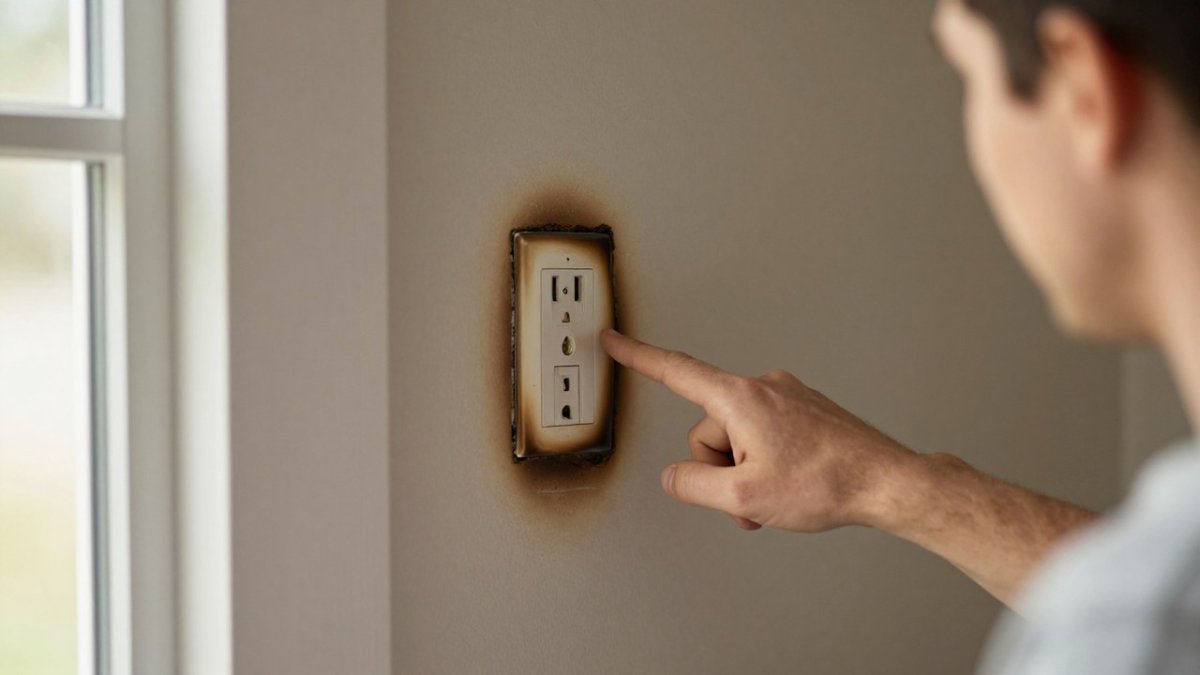
The warning signs below are the ones we treat as serious on every call. Each one points to a possible electrical fault that can escalate quickly.
Warm, Discolored, or Scorched Outlets and Switches
An outlet or switch that feels warm is overheating. A faceplate that has yellowed, browned, or cracked shows heat damage. Either means the connection behind the wall is generating more heat than it should, usually from a loose connection or corrosion on the terminals.
Stop using that outlet and have it inspected. If you want help judging whether the wiring behind your walls is outdated, how to identify outdated wiring in old homes walks through the visual clues safely from the outside.
Burning Smells, Scorch Marks, and Unusual Sounds
A burning smell near an outlet, switch, or the electrical panel is an emergency. Turn off power at the breaker if you can do so safely, leave the area, and call for help.
The same goes for buzzing, crackling, or sizzling sounds from a switch, outlet, or panel. These usually mean arcing, electricity jumping across a gap, one of the most common causes of electrical fires.
Urgent Danger Versus Routine Inspection: When to Act Now
Call immediately, day or night, if you smell burning, see smoke or scorch marks, hear crackling or buzzing from a device or panel, or feel heat at an outlet or switch. These point to active arcing or overheating and belong in the emergency category.
Schedule an inspection soon, within days rather than months, for repeated breaker trips, flickering lights, warm outlets without discoloration, or a panel that is warm to the touch.
Book a routine inspection if you have none of these symptoms but your home is older, you have added major appliances, or you are planning renovations. For older homes, why electrical fire prevention is critical for old homes explains how aging wiring fails quietly over decades.
What Homeowners Can Safely Observe Without Opening Equipment
You can gather a lot of useful information without touching a screwdriver. A visual walk-through gives an electrician a head start and helps you spot changes early.
- Check for outlets or switches that feel warm
- Look for yellowed, cracked, or scorched faceplates
- Note any lights that flicker or dim, and when
- Listen for buzzing or crackling near devices and the panel
Never remove a panel cover, unscrew an outlet, or poke inside a device. The panel and its busbars carry live current even with the main breaker off in some setups. Observation is safe; opening equipment is not.
Your Electrical Inspection Checklist for a Safer Home
A proper electrical inspection is a structured process, not a quick glance at the panel. Knowing what a licensed electrician actually does, and what you should receive, helps you judge whether an inspection was thorough.
What a Licensed Electrician Checks
A standard residential inspection typically covers:
- Service entrance and meter: Condition of the service drop or lateral, meter base, and main disconnect, checking for corrosion, loose fittings, and overheating.
- Breaker panel and busbars: With the cover removed by the electrician, the panel is checked for double-tapped breakers, undersized or aluminum branch wiring, scorched busbars, and mismatched breakers.
- Grounding and bonding: The grounding electrode conductor, water and gas bonding, and ground path integrity. Poor grounding is common in older homes.
- Outlets and switches: A representative sample is tested for polarity, open grounds, and GFCI protection, plus warm faceplates, discoloration, and backstabbed connections.
The Inspection Process, Step by Step
Most inspections follow a predictable sequence:
- Interview and walk-through. The electrician asks about symptoms, breaker trips, flickering, warm outlets, and walks the home with you.
- Panel and service inspection. The electrician removes the panel cover (never you) and inspects service equipment, grounding, and branch terminations.
- Device and circuit testing. Outlets, switches, GFCIs, and AFCIs are tested with a meter and tester; breakers may be tripped intentionally to map circuits.
- Load and capacity review. Service and panel are compared against actual and planned load.
- Written findings and recommendations. You receive a report of what was found, what is urgent, what is routine, and what repairs or upgrades are recommended.
What Your Inspection Report Should Include
A useful report lists each finding with its location, likely cause, and priority level, emergency, urgent, or routine. It should distinguish code-required corrections from recommended upgrades and give a clear scope for repairs so you can compare quotes.
Watch out: a verbal "everything looks fine" with no written findings is not an inspection report. Ask for the findings in writing, even if the summary is short.
How Findings Are Prioritized
Electricians typically sort findings into three buckets. Emergency items, arcing, scorching, overheating at the panel, or exposed live conductors, are corrected or de-energized immediately. Urgent items, double-tapped breakers, missing GFCI protection in wet areas, undersized wiring on a heavily loaded circuit, should be scheduled within days to weeks. Routine items, aging but intact wiring, recommended AFCI upgrades, panel labeling, can be planned into a maintenance budget. This prioritization turns an inspection into an actionable plan rather than a list of worries.
If you want a practical walkthrough of what a safety inspection covers, our guide on whether your home's electrical systems are safe lays out five checks you can review before you book.
How Often Should Electrical Systems Be Inspected?
The right inspection interval depends on the age of the wiring, the condition of the panel, and whether the home has had major additions.
Book an inspection sooner if you are buying a home, planning a renovation, adding an EV charger or large appliance, or if the home still has outdated wiring. Local code requirements also set inspection standards for certain work, and our guide to local electrical code compliance explains what those rules cover.
What Electrical Inspection Cost Depends On
Pricing for an electrical inspection depends on the scope, the size and age of the property, and what the electrician finds once the panel cover comes off. Understanding the cost drivers helps you compare quotes fairly and avoid surprise charges.
The Main Cost Drivers
- Property size and age. A 1,200-square-foot ranch with one panel takes less time than a 3,500-square-foot home with a main panel, subpanel, and outbuildings. Older homes take longer to document, knob-and-tube, aluminum branch wiring, and ungrounded circuits all require notes and testing.
- Number of panels and circuits. Each subpanel adds inspection and testing time.
- Scope of the inspection. A focused pre-offer walk-through is narrower than a full safety inspection with load calculation, GFCI/AFCI testing, and a written report.
- Access and condition. A panel in a finished basement or crawlspace takes longer to access than one in a garage; a crowded, mislabeled, or overheating panel requires more careful documentation.
- Repairs and corrections. Repair work is quoted separately from the inspection, so you can decide what to authorize.
How to Compare Inspection Quotes
Ask each electrician what the quote includes: Is the panel cover removed and the busbars inspected? Are GFCIs and AFCIs tested? Is a written report provided? Is a load calculation included? A low quote covering only a visual walk-through is not the same service as a full inspection with a written report.
When comparing quotes, ask specifically what is and is not included before you book.
What Affects the Final Bill
Pricing depends on the scope of the inspection and any repairs found. Ask about after-hours rates and repair pricing before work begins.
For current pricing on your property, request a quote from Hriczak Electrical Contracting LLC through our website.
Schedule Your Electrical Inspection Before a Small Fault Becomes a Fire Risk
The warning signs in this guide share one trait: they get worse quietly. A warm outlet becomes a scorched one. A breaker that trips weekly becomes a panel that fails.
If you are ready to act, find a reliable 24 hour electrician and get an inspection on the calendar.
Do not wait for a warning sign to become an emergency.
Frequently Asked Questions
What should you do if an outlet feels warm or smells like burning?
Stop using the outlet immediately and unplug anything connected to it. A warm faceplate, a burning odor, or visible scorch marks point to overheating, loose connections, or damaged wiring inside the wall. Turn off the circuit at the breaker panel if you can do so safely, then call a licensed electrician. Do not open the outlet yourself or keep resetting the breaker. These symptoms are among the clearest signs of faulty electrical wiring and can lead to a fire if ignored.
How often should your home electrical system be checked?
The right inspection timing depends on age and use. Homes over 40 years old, properties with aluminum or outdated wiring, and houses that have had major renovations or added heavy loads such as EV chargers should be inspected sooner. If you notice frequent breaker trips, flickering lights, or warm switches, book an inspection right away rather than waiting for the next interval.
What will fail an electrical inspection?
Common failures include an undersized or damaged electrical panel, double-tapped breakers, missing GFCI protection in kitchens and bathrooms, exposed or damaged wiring, ungrounded outlets, and overloaded circuits relying on extension cords. Corrosion, loose connections, and missing cover plates also come up. A licensed electrician will document each issue and explain which repairs are urgent versus routine, so you know what has to be fixed before the system is considered safe.
How much does a typical electrical inspection cost?
Electrical inspection cost depends on the size of the property, the number of panels and circuits, and whether the visit is a routine safety check or a full diagnostic after a problem. Emergency calls, older homes with outdated wiring, and commercial spaces with switchgear or busbars take longer and affect the total. Request a quote from Hriczak Electrical Contracting LLC through our website for current pricing before work begins.